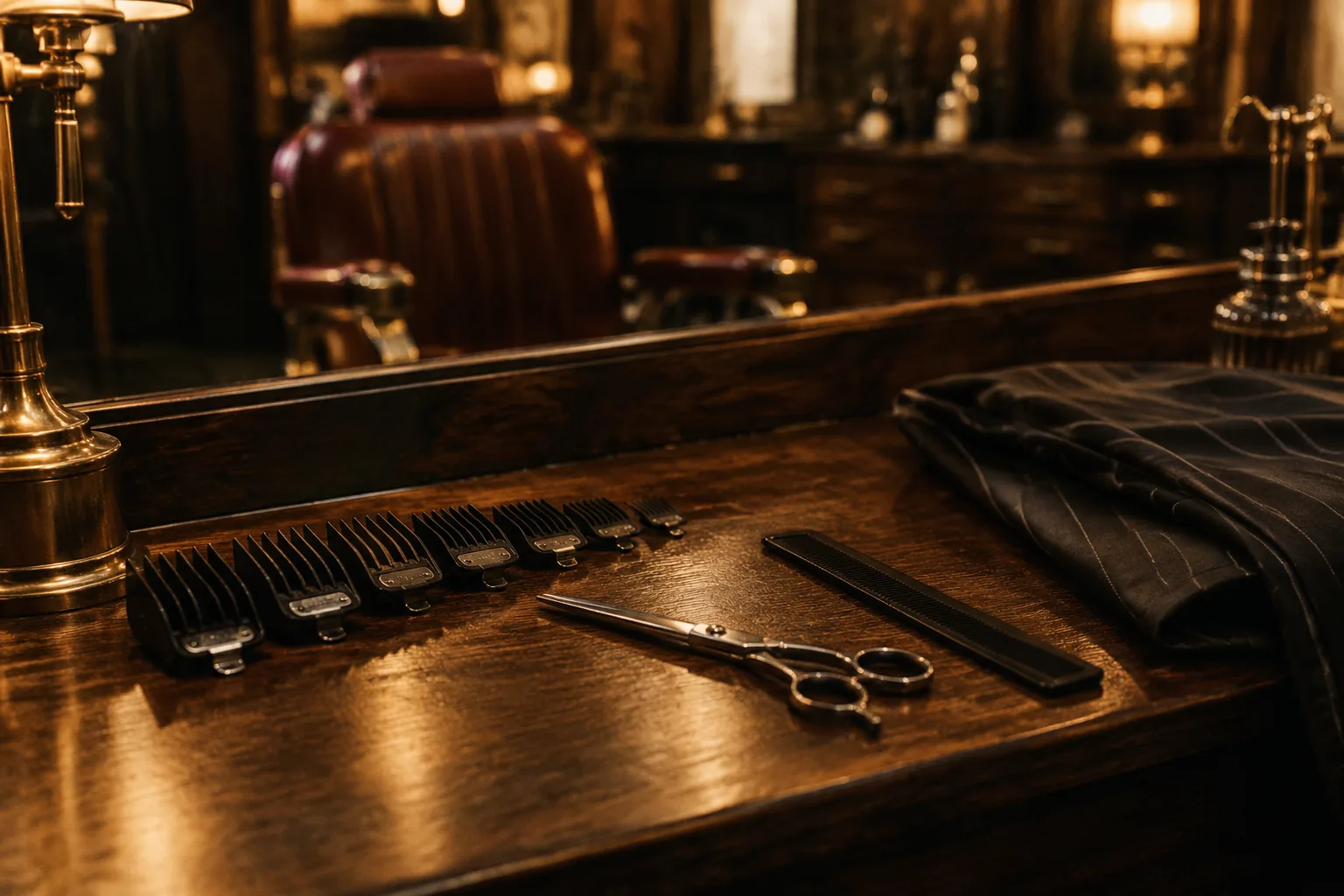
A number 1 guard leaves about an eighth of an inch, a 2 leaves a quarter inch, a 3 leaves three eighths, and each step up adds another eighth, so a 4 is half an inch and an 8 is a full inch. Knowing that one pattern lets you describe almost any clipper cut precisely, with no vocabulary beyond a number and a direction.
Clipper guards are the plastic combs that snap onto the blade and set how much hair stays. Most barbers think in these numbers all day, and most clients have heard them without anyone explaining what they mean. This guide covers the numbers, then the other words that decide what you walk out with. If it is your first visit anywhere, our first-time guide covers the full sequence of the appointment.
The numbers
What each guard leaves behind
These are the standard sizes on the most common professional clipper guards. Brands differ slightly, so treat them as close, not exact. A good barber will confirm the length against your head before committing.
- No guard (the bare blade): very short, close to the skin. This is what a fade uses at the bottom.
- Number 1: about 1/8 inch, 3 millimeters. A military-short buzz.
- Number 2: about 1/4 inch, 6 millimeters. The classic short, even buzz.
- Number 3: about 3/8 inch, 10 millimeters. Short but with visible hair.
- Number 4: about 1/2 inch, 13 millimeters. A solid short length that still lies flat.
- Number 5 to 8: 5/8 inch up to 1 inch, 16 to 25 millimeters. Usually used on top, or for a longer taper.
A quick way to remember it: each number is one eighth of an inch. Number 3 is three eighths. Number 6 is six eighths, or three quarters. Once you see it that way, you never have to guess what an unfamiliar number means.
The catch
Numbers describe the clipper, not the haircut
The guard number only tells you the length at the starting point. It does not say how the length changes from the bottom of the head to the top, and that gradient is what makes a cut look like a fade, a taper or a flat buzz. Two men can both ask for "a 2 on the sides" and get very different results:
- A number 2 all over the sides is a uniform short cut with a hard transition to the top.
- A number 2 at the top of the sides, fading down to the bare blade is a fade. The "2" is the longest point, not the whole cut.
That is the gap between a guard number and a haircut. Use the number for length, then use words for shape. Our fade versus taper guide and the breakdown of burst, skin and drop fades cover the shape side in depth.

The vocabulary
Eight words that do the heavy lifting
Blend
How smoothly one length meets the next. "Blend it high" or "blend it low" decides where that gradient happens.
Line-up
Sharp lines at the hairline and temples, cut with a trimmer or razor. Also called an edge-up or shape-up. It frames the cut. It is not the haircut itself.
Off the ears
Clippers clear the ear completely. Without it, the hair sits on or around the ear. Say which one you want.
Natural neckline means the back is left to taper off on its own, with no hard line. Blocked or squared means a straight horizontal cut across the nape, which looks crisp for about ten days and then grows into a shelf. Rounded sits between the two and ages best. Scissor over comb is the technique for blending longer lengths with shears, used when a clipper guard would be too blunt. Texture means a barber removes weight or adds movement to the top so it does not sit like a flat helmet. Part is either a defined line cut into the hair (a hard part) or a natural one you comb into place.
How to use it
A short script that works in any chair
Put the instruction in this order, and you give your barber everything needed in under a minute:
- Sides and back: "A number 2 on the sides, faded down, off the ears, natural neckline."
- Top: "Keep about two inches, textured, brushed back."
- Finish: "Light line-up, no hard part."
- Maintenance: "I will be back in three weeks."
If you do not know the numbers, show a photo and say "about this length, sides and back." If you have no photo, say how long you want it to last and how you wear it. A barber can reverse-engineer the numbers from that.
One caution
Do not over-trust the number
Hair is not uniform. A number 2 on thick, dense hair stands up and reads as a hard buzz. The same guard on fine or thinning hair lies flat and shows more scalp. Hair on the crown grows in a swirl and can look different from the sides at the same length. That is the reason a good barber starts longer and goes shorter: you can always take more off, never put it back.
If you are trying a shorter length than usual, ask your barber to start one guard longer than you think you want and check it in the mirror. That one-step margin costs a minute and saves a regret.
Practical
Where this fits on the Dapper Fellas menu
A single-length or simple fade clipper cut is the Clean Fade or Clipper Buzz Cut, 25 minutes for $30. Anything with scissor work on top is the Dapper Signature Haircut, 45 minutes for $50. Each includes a head wash and hot towel. If you are weighing the price against the time, here is what the minutes buy.
FAQ
A number 2 clipper guard leaves about a quarter inch, or 6 millimeters, of hair. Guard numbers go up in steps of an eighth of an inch, so a 1 is about 1/8 inch, a 3 is about 3/8 inch and a 4 is about half an inch. Exact lengths vary slightly by clipper brand.
A number 1 leaves about 1/8 inch and looks close to a military buzz. A number 2 leaves about 1/4 inch and looks like a short, even cut. On darker hair the difference is easy to see. On lighter hair it is subtler.
A line-up, also called an edge-up or shape-up, is a set of sharp lines cut at the hairline and temples with a trimmer or razor. It frames the haircut and makes it look fresh. It is a finishing touch, separate from the cut itself.
Show a reference photo, say how long you want it to last, and describe how you style it. "About this length on the sides, longer on top, back in three weeks" gives a barber everything needed. Not knowing the numbers is completely normal and nobody will judge it.
No. A number 1 is a single uniform length. A fade grades from very short at the bottom up into longer hair, so the guard number only describes the longest point of the fade, not the whole cut.